
Ask any flight instructor which instrument students misread most, and the turn coordinator is usually near the top of the list. That little white airplane symbol tells you two different things at two different times, it shares its case with a second instrument (the inclinometer), and it goes by at least three different names — turn coordinator, turn and slip indicator, and turn and bank indicator — depending on the aircraft and the decade it was built.
This guide untangles all of it: what the turn coordinator actually indicates, how the canted rate gyro inside it works, how it differs from the older turn and slip indicator, what the ball is really telling you about slips and skids, and how to fly a perfect standard rate turn.
Quick answer: A turn coordinator provides an indication of the rate of roll (when rolling into or out of a turn), the rate of turn (once the bank is established), and — via the inclinometer ball — the quality (coordination) of the turn. When the miniature aircraft's wingtip aligns with the standard rate index, the aircraft is turning at 3° per second: a full 360° turn in exactly 2 minutes.
Turn Coordinator vs Turn and Slip Indicator vs Turn and Bank Indicator
These three names cause endless confusion because they describe two closely related instruments — one of which has two names. Here's the whole picture in one table:
| Instrument | Displays | Senses | Gyro Orientation | Found In |
|---|---|---|---|---|
| Turn coordinator | Miniature airplane banking | Rate of roll and rate of turn | Gyro canted ~30° from horizontal | Most modern GA aircraft (Cessna 172, Piper PA-28, etc.) |
| Turn and slip indicator | Vertical pointer (needle) | Rate of turn only | Gyro horizontal | Older aircraft, some aerobatic & classic types |
| Turn and bank indicator | Same as turn and slip | Rate of turn only | Gyro horizontal | Older name for the turn and slip indicator |
| Inclinometer (the ball) | Ball in a curved glass tube | Coordination — slip or skid | No gyro (gravity + inertia) | Built into all of the above |
The key facts to remember:
- "Turn and bank indicator" and "turn and slip indicator" are the same instrument — a needle-style rate-of-turn gauge. The name changed over the years, but the mechanism didn't. Despite the name, it does not directly indicate bank angle.
- The turn coordinator is the newer design. By canting the gyro roughly 30° from horizontal, it responds to roll rate as well as turn rate — so it reacts the instant you begin rolling into a turn, before the turn is even established. The older needle instrument only responds once the aircraft is actually turning.
- Neither instrument shows bank angle. The miniature airplane in a turn coordinator banks to show rate, not attitude. Two aircraft at very different bank angles can both show a standard rate turn if their airspeeds differ. Bank angle comes from the attitude indicator.
- Both include an inclinometer — the ball — which is a completely independent, non-gyroscopic instrument that shows whether the turn is coordinated.
What Is a Turn Coordinator?
The turn coordinator is one of the six primary flight instruments — the classic "six-pack" — found in most general aviation cockpits. It sits in the bottom-left position of the panel and combines two instruments in one case:
- A rate gyro driving the miniature airplane symbol, showing rate of roll and rate of turn
- An inclinometer (the ball in the curved tube below), showing the quality of the turn
Together they answer two questions no other single instrument can: How fast am I turning? and Is this turn coordinated?
Most turn coordinators are electrically powered, deliberately so. The attitude indicator and heading indicator typically run off the vacuum system — so if the vacuum pump fails in instrument conditions, the electric turn coordinator keeps working. That redundancy is why the turn coordinator is the backbone of partial-panel instrument flying.
How Does a Turn Coordinator Work?
Inside the case is a rate gyro mounted in a single gimbal, canted upward about 30° from horizontal. This cant angle is the entire secret of the instrument.
A gyroscope resists changes to its orientation and reacts to rotation through precession — a force applied to a spinning gyro produces movement 90° later in the direction of rotation. In the turn coordinator:
- When you roll the aircraft, the canted gyro senses the roll and precesses, tilting the miniature airplane immediately — this is the rate of roll indication.
- Once established in the turn, the gyro senses the yaw component of the turn and holds the miniature airplane at a deflection proportional to the rate of turn.
- A spring returns the mechanism toward neutral, calibrated so the wingtip touches the lower index mark exactly at a 3°-per-second turn.
Because of the canted gyro, the turn coordinator gives you an instant cue as you begin rolling — long before the older turn and slip indicator's needle would move. That responsiveness is why it replaced the needle instrument in most training aircraft.
One important limitation: because it senses roll, the turn coordinator will show a deflection during a wings-level yaw (like taxiing turns — which is actually how you preflight it) and it cannot distinguish a banked turn from certain rolling motions. It is a rate instrument, never an attitude instrument. The placard on the face says it plainly: "NO PITCH INFORMATION."
The Inclinometer: Reading the Ball
Below the miniature airplane sits a black ball in a curved, fluid-damped glass tube. This is the inclinometer (also called the slip/skid indicator), and it has nothing to do with the gyro — it's simply a ball responding to gravity and centrifugal force.
| Ball Position | Condition | What's Happening | Correction |
|---|---|---|---|
| Centered | Coordinated | Forces balanced — the aircraft is turning exactly as fast as the bank angle demands | None — nicely done |
| Inside the turn (low wing side) | Slip | Not enough rate of turn for the bank angle — too little rudder | Add rudder pressure on the ball side ("step on the ball") |
| Outside the turn (high wing side) | Skid | Too much rate of turn for the bank angle — too much rudder | Relax rudder, or step on the ball side |
The memory aid every CFI teaches: "step on the ball." Whichever side of center the ball sits, apply rudder pressure on that side and it will return to center.
Coordination matters for comfort — uncoordinated flight is what makes passengers queasy — but far more importantly for safety. A skidding turn from base to final is the classic setup for a stall/spin accident: the aircraft stalls with pro-spin yaw already applied, at an altitude too low to recover. If you want to go deeper on this, our full guide to slips vs skids breaks down the aerodynamics of both.
The Standard Rate Turn: 3° Per Second
The lower index marks on the turn coordinator (often labeled "2 MIN") mark the standard rate turn: 3° of heading change per second. At that rate, a full 360° turn takes exactly 2 minutes, and a 180° course reversal takes 60 seconds.
Standard rate is the language of instrument flying. ATC expects it, holding patterns and procedure turns are built on it, and timed compass turns depend on it. Fly the wingtip to the index and time becomes your heading indicator.
The bank angle required for a standard rate turn depends on your true airspeed. The rule of thumb: divide true airspeed by 10, then add 7 (some teach adding half of the result — both get you close).
| True Airspeed | Approx. Bank for Standard Rate | Typical Aircraft |
|---|---|---|
| 80 knots | ~15° | Cessna 152 on approach |
| 100 knots | ~17° | Cessna 172 in cruise |
| 120 knots | ~19° | Piper Arrow, C182 |
| 140 knots | ~21° | Bonanza, Cirrus SR20 |
| 180 knots | ~25° | Light twins, turboprops |
This is exactly why the turn coordinator can't show bank angle: a 152 and a King Air both showing standard rate are at very different bank angles. Faster aircraft (jets, and anything above roughly 250 knots) use half standard rate instead, because the bank angle required for full standard rate would exceed comfortable limits.
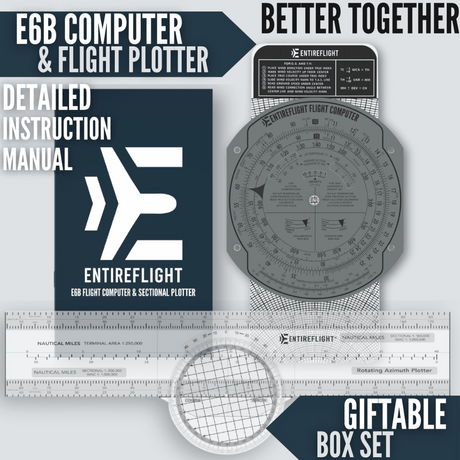
Working out bank angles, timed turns, and wind corrections is bread-and-butter E6B math — the same calculations our E6B Flight Computer & Plotter Bundle and the free EF1 E6B app handle in seconds during checkride prep.
Preflighting the Turn Coordinator
The turn coordinator is one of the few gyro instruments you can meaningfully test before takeoff:
- Power check: With the master on, the gyro should spool up — no OFF flag visible, no unusual grinding.
- Taxi check: During taxi turns, the miniature airplane should bank into each turn (left turn → left deflection) while the ball swings outside the turn. "Needle left, ball right" in a left taxi turn means both components work.
- Flag check: Any visible warning flag means the instrument is unreliable — a no-go for IFR flight.
When Things Fail: The Turn Coordinator in Partial Panel
Because it's electrically driven while the attitude and heading indicators are vacuum-driven, the turn coordinator is your lifeline when the vacuum system dies in the clouds:
- Wings level: Keep the miniature airplane level and the ball centered — that's your substitute attitude indicator for bank.
- Timed turns: Establish standard rate, then time the turn: heading change ÷ 3 = seconds required. A 90° heading change takes 30 seconds at standard rate.
- Compass turns: Combined with magnetic compass lead/lag corrections, timed standard rate turns get you through an entire approach without an attitude indicator.
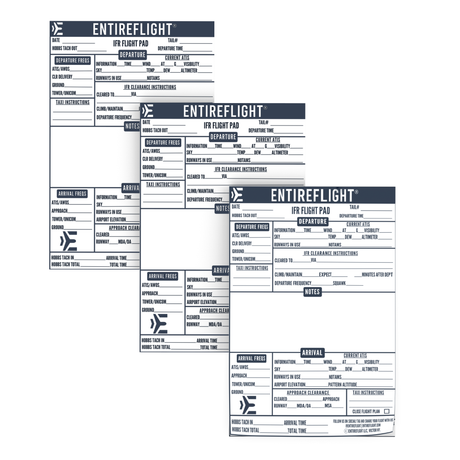
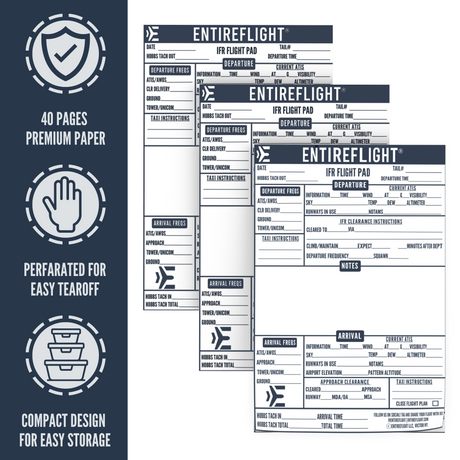
Instrument students drill this endlessly for good reason — a vacuum failure in IMC without those skills is a genuine emergency. Keeping a structured IFR notepad on your kneeboard for timing and headings makes partial-panel work dramatically less chaotic.
Glass Cockpit Equivalents
In glass cockpits (G1000, Avidyne, Dynon), the standalone turn coordinator disappears, but its functions remain:
- Rate of turn becomes a magenta trend vector or tick marks on the HSI/heading display — the "turn rate indicator" showing where the heading will be in 6 seconds.
- The inclinometer becomes the slip/skid indicator: a small trapezoid segment under the sky pointer on the attitude display. Segment displaced = same as ball displaced, and "step on the ball" still applies.
- AHRS (solid-state attitude and heading reference systems) replace the spinning gyros entirely — no vacuum pump to fail, though electrical redundancy becomes even more critical.
Keep Learning the Six-Pack
Gear That Makes Instrument Training Easier
- E6B Flight Computer & Sectional Plotter Bundle — master the timed-turn and wind math the old-school way (your examiner will love it)
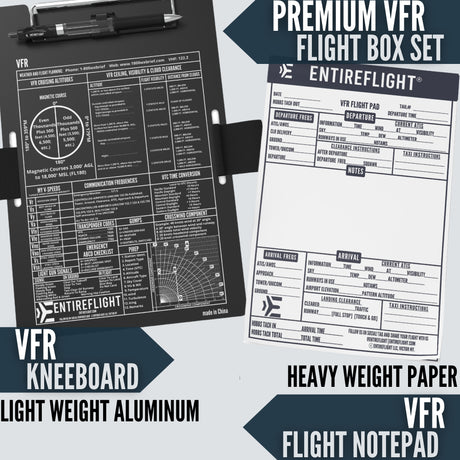
- VFR Pilot Kneeboard & Flight Pad — structured note-taking for clearances, headings, and times
- IFR Flight Notepad — purpose-built for approach briefings and partial-panel timing
FAQs
What does a turn coordinator provide an indication of?
A turn coordinator indicates the rate of roll (as you enter or exit a turn), the rate of turn (once established), and — through its inclinometer ball — the coordination or quality of the turn. It does not indicate bank angle or pitch.
What is the difference between a turn coordinator and a turn and slip indicator?
The turn and slip indicator uses a horizontally mounted gyro and a vertical needle that responds only to rate of turn. The turn coordinator's gyro is canted about 30°, so it senses rate of roll as well, displaying both on a miniature airplane symbol. Both instruments include an identical inclinometer ball.
Is a turn and bank indicator the same as a turn and slip indicator?
Yes — "turn and bank indicator" is the older name for the turn and slip indicator. Despite the name, it doesn't directly indicate bank angle; it shows rate of turn (needle) and coordination (ball).
What is a standard rate turn?
A standard rate turn is 3° of heading change per second — a complete 360° turn in 2 minutes. The turn coordinator's index marks (labeled "2 MIN") show exactly this rate, which is the expected turn rate for most IFR maneuvers.
What bank angle gives a standard rate turn?
It depends on true airspeed: roughly TAS ÷ 10 + 7. At 100 knots that's about 17°; at 140 knots about 21°. This is why the turn coordinator cannot substitute for an attitude indicator — the same turn rate requires different bank angles at different speeds.
What is the ball in the turn coordinator called?
The inclinometer, also called the slip/skid indicator. It's a gravity-and-inertia instrument, completely independent of the gyro, that shows whether the turn is coordinated.
What does it mean when the ball is not centered?
Ball displaced toward the inside of the turn = slip (not enough rudder). Ball displaced toward the outside = skid (too much rudder). In both cases, apply rudder pressure on the side the ball is deflected — "step on the ball."
Why is the turn coordinator electric instead of vacuum-powered?
For redundancy. The attitude and heading indicators typically run on the vacuum system, so powering the turn coordinator electrically means a single system failure can't take out all of your gyro instruments — the foundation of partial-panel instrument flying.
Can you fly with a failed turn coordinator?
Under VFR, often yes — check FAR 91.205, which doesn't require one for day or night VFR (it does appear in the IFR equipment list as a rate-of-turn indicator). For IFR flight, a working rate-of-turn indicator and slip/skid indicator are required equipment.